


BobCustomer story
★★★★★
Glad I tried it first
The body shop estimate was around $300 for a small door dent. I already had a compressor, so I gave this a shot at home. It took a few pulls, and the panel isn't perfect, but I'm happy with it.
2026's Best DIY Dent Repair Tool
Pulls door dings out in your own driveway with real vacuum grip from the compressor you already own. No glue. No $500 body-shop bill.
FREE Cup Expansion Pack Included when you choose the 3-Cup Kit ($40 value).
Couldn't load pickup availability
Try Clenvox at home with confidence. Your tool is covered for one year, with a 60-day money-back guarantee.
Free US Shipping · 5–7 days
-
Ordered
- - -
Order Ready
- - -
Delivered
Snap the 1/4" quick-connect onto your garage compressor hose and flip the lever. The solid brass valve turns air pressure into vacuum, so the cup locks onto the panel. Work the slide hammer with steady pulls and the metal walks back to shape.
No glue to heat, no tabs to twist off, no holes drilled. Nothing but the rubber cup touches your paint.
Best for: shallow dents and door dings on flat steel panels with intact paint. Sharp creases and dents on a body line are a job for a shop.
Shipping: Free standard shipping on all US orders. Delivered in 5–7 days.
60-Day Money-Back Guarantee: If it doesn't pull your dent, or you're not happy with it, contact us within 60 days of delivery for a full refund.
1-Year Warranty: If the valve, a cup or the slide hammer breaks within a year, we'll replace it.


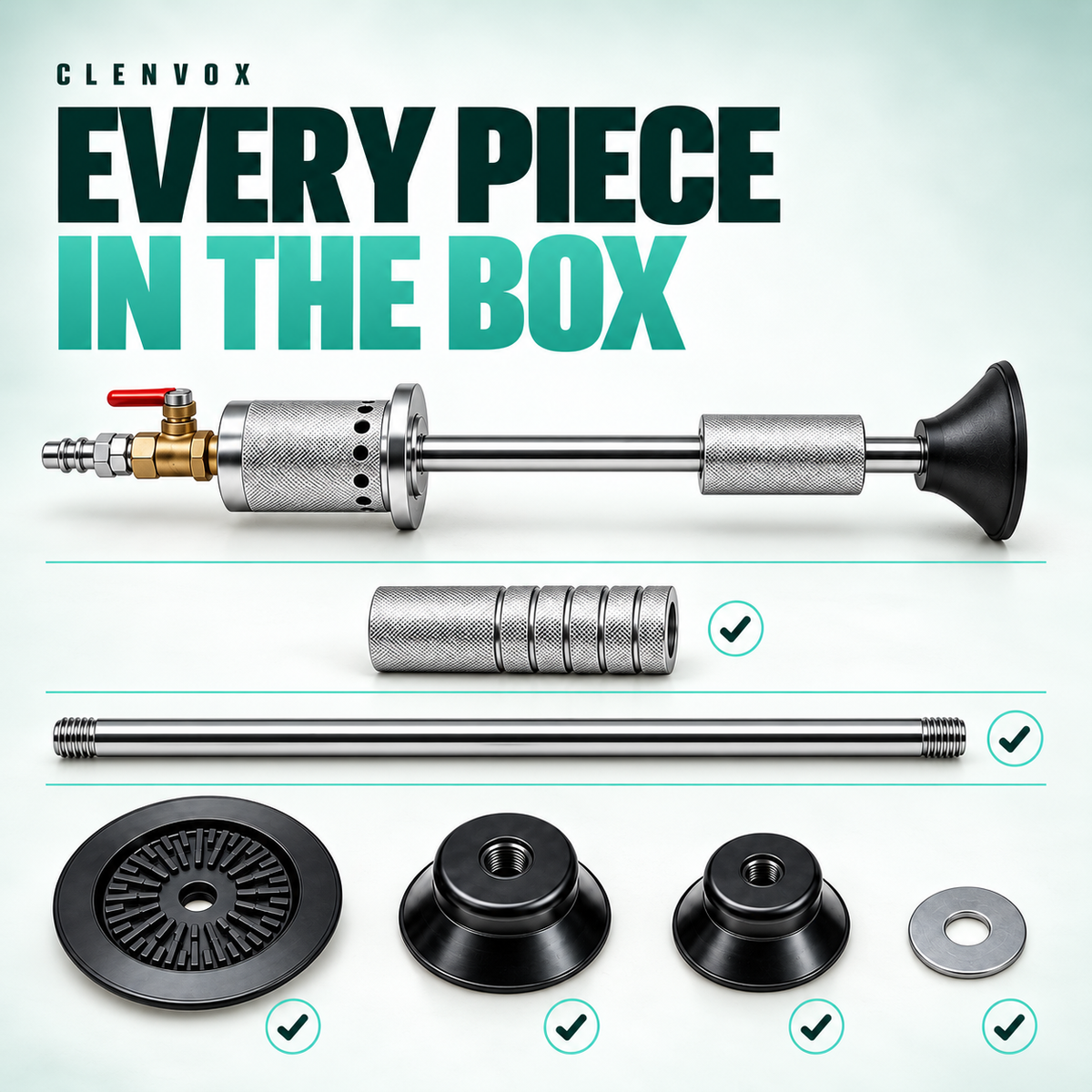
Real Vacuum Grip, Not a Plunger
Your compressor feeds the brass valve and the cup locks onto the panel hard enough to yank on.
Nothing but the Cup Touches Your Paint
No glue, no tabs, no drilling. Factory paint stays factory.
Built to Take a Beating
Solid brass valve, cups up to 15cm and a 1-year warranty. No plastic puller heads to snap on the first pull.
Pays for Itself on the First Dent
A body shop can charge $500 to fix one door. Clenvox costs less than a single visit, and it stays in your garage for the next ding.
1 Snap the quick-connect onto your compressor hose
2 Wipe the panel, set the cup over the dent and open the valve
3 Work the slide hammer with steady pulls until the dent pops
Done? Release the valve and the cup lifts straight off. Nothing left on your paint.
| Clenvox™ | Cheap Kits | |
|---|---|---|
Grip that holds on hard pulls |
||
No glue, no residue |
||
Safe on factory paint |
||
Solid brass valve |
||
No glue gun or outlet needed |
||
60-day money-back guarantee |
||
1-year warranty |
It works best on shallow, rounded dents on flat steel panels with intact paint: door dings, shopping-cart hits and soft dents on doors, fenders, hoods, roofs and tailgates. Sharp creases, dents on a body line and cracked paint are a job for a body shop.
Yes. Clenvox runs on the compressor in your garage through a standard 1/4" quick-connect fitting. No compressor, no pull. That is the trade for real vacuum grip with no glue.
Cheap kits use thin valves and small cups that leak air. Clenvox uses a solid brass valve and cups up to 15cm, so the seal holds while you work the slide hammer. If it doesn't pull your dent, the 60-day money-back guarantee covers you.
No glue, no drilling, no heat. The cup grips with vacuum only, so your factory finish stays put. Clean the panel first so the rubber seals well, and release the valve before lifting the cup off.
Steel body panels: doors, fenders, hoods, quarter panels, tailgates and roofs. Aluminum panels are stiffer and take more pulls. It is not for plastic bumpers, trim or glass.
Most door dings start moving within 60 seconds. Bigger or stubborn dents can take a few more pulls. Go slow and work from the shallow edge of the dent inward.
If you can hook up an air hose, you can use it. Connect, seal the cup over the dent, open the valve and work the slide hammer with steady pulls.
Motorcycle tanks, RVs, truck beds, toolboxes and appliances, as long as the metal is smooth enough for the cup to seal.
You have 60 days to try it. If it doesn't pull your dent or you're not happy, contact us for a full refund. If the valve, a cup or the slide hammer breaks within a year, we replace it.
Free standard shipping on all US orders. Delivered in 5–7 days.
Filmed in a real garage on a real car. No filters, no tricks, just a compressor, a cup and a few pulls.
These stories cover the questions drivers ask most: whether the cup will hold, which dents are suitable, what a first attempt feels like, and when a professional is still the better choice. The tool needs an air compressor; results vary with the panel and dent shape.
The body shop estimate was around $300 for a small door dent. I already had a compressor, so I gave this a shot at home. It took a few pulls, and the panel isn't perfect, but I'm happy with it.
I cleaned the dented part of my truck first and used the cup that covered it best. The seal stayed put while I worked the slide hammer. Both shallow dents came out enough that I stopped thinking about a shop visit.
I had a shallow ding on my truck door. Getting the cup seated took a couple of tries, but after that the slide hammer was straightforward. It looks a lot less noticeable now.
I used a glue kit before and hated the cleanup. With this one, I connected the air line, pulled the dent, and released the valve to lift the cup off. Much easier for me.
Worked well on the shallow dents in the roof of my Airstream. I had to move the cup around and make a few pulls. It wasn't a one-shot thing, but it made a real difference.
I bought this for a roof dent on my daughter's Malibu. I cleaned the spot, got the cup to seal and gave it a few steady pulls. The metal moved more than I expected. Glad I didn't start with a shop appointment.
The ding in my truck door wasn't huge, but I noticed it every time I walked past. I already had an air compressor and tried this in the driveway. Took me a bit to get the cup centered; the door looks much better now.
Used it on a broad, shallow dent in my truck tailgate. The cup grabbed better after I wiped the panel clean. It didn't make the truck new again, but from a few feet away I barely notice the dent.
I used it on three dents. Two came out nicely; one deeper spot still shows when the light hits it from the side. For a driveway fix I'm pleased, just don't expect every panel to look factory-new.
I wasn't sure which cup kit made sense for the dent on my hood, so I sent the shop a photo. They got back to me with a clear answer instead of a canned sales pitch. The smaller cup was the one I ended up using.
I'm handy around the house but had never worked on a car panel. The air hose connection was simple. I went slowly, repositioned the cup once and got the shallow door ding looking better. It takes a little patience.
The tool feels solid and the cup held, but I couldn't get the sharp part of my dent on a body line to move much. I stopped before making it worse. I'd use it again on a smoother dent; this one needs a pro.
I picked it up for a small dent on my car and later tried it on a broad, shallow spot on a motorcycle tank. The cup needs a smooth place to seal. Both looked better afterward, and the tool went back on my shelf for next time.
I bought it for a shallow dent in the hood, nothing on a crease. I cleaned the panel and made a few steady pulls. It came up enough that I don't feel the need to repaint that area.
First try, the cup kept slipping and I thought it wasn't going to work. I wiped the panel and the edge of the cup, then it held while I pulled. Worth taking an extra minute to prep the surface.
I was nervous about trying a dent puller on my own truck. The setup was less complicated than I expected, and a shallow dent moved after a few controlled pulls. I wouldn't try it on a sharp crease, though.
I've used a few dent repair tools. This is the one I reach for when there's a broad, smooth dent and room for the cup to sit flat. It isn't for every mark on a car, but it has earned a place in my garage.
My tracking page didn't update at first, so I emailed the shop. Someone replied the next day with the order status and a working tracking link. The package arrived and everything I ordered was in the box.
I sent support a photo because the cup wouldn't stay on my door. They suggested cleaning the panel and trying the other cup size. That did it. I appreciated getting a useful answer without going back and forth all week.
The large cup didn't sit flat on my door, but the smaller one fit the shallow ding and held much better. It took more than one pull. I'm happy with the improvement and glad the kit had different sizes.
Won't fix everything, but it pulled two sizeable dents enough that the truck looks presentable again. Up close I can still see one spot. For what I wanted, that was fine.
It took me a few minutes to connect the air line and get the cup positioned. Once it sealed, I could work the slide hammer without it popping loose. The dent improved, though I had to come at it more than once.
I had a dent with a wide shallow area and a sharper mark near the edge. This pulled the wide part up, but the sharp mark is still there. The result is better, just not a complete fix for that shape.
The valve started leaking on my second repair, so I couldn't finish the job that weekend. Support answered my message and arranged a replacement part, which I appreciate. Still frustrating to have to stop halfway through.

